


How to Select a Filter Bag for a Cement Plant
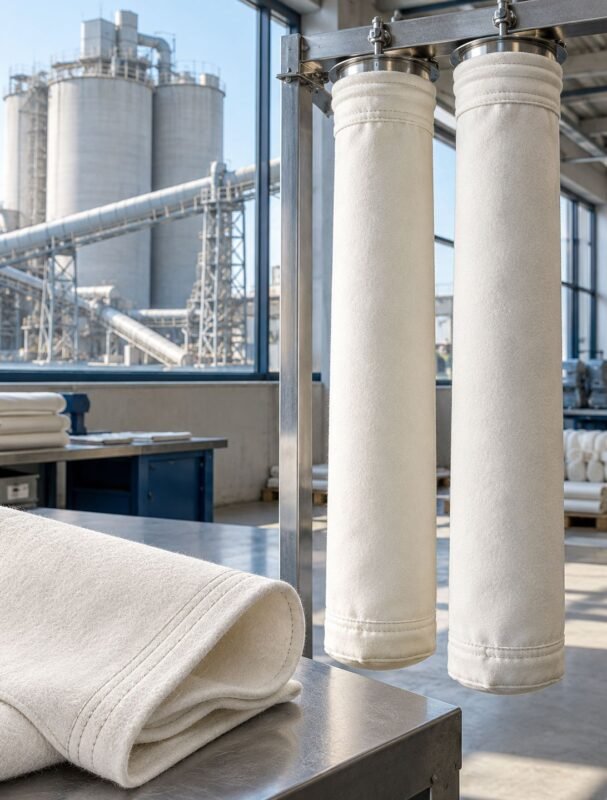 Cement plant filter bag selection requires the characteristics of the dust generated during production to be considered alongside the filtration system’s operating conditions. Filtration efficiency, abrasion resistance, temperature resistance, chemical compatibility and dimensions suited to the equipment are the main selection criteria.
The right product cannot be identified by its purchase price alone. Bag life, maintenance requirements and suitability for the system’s operating conditions are also part of the total cost. Process data for the relevant unit should therefore be collected before selection.
Filtration efficiency of cement plant filter bags
The primary function of a filter bag is to capture particles in a dust-laden gas stream. The required performance should be assessed according to particle size, filter media structure and the target outlet emissions. Fibre structure and surface properties may become more important in applications involving fine dust.
The suitability of the filter media cannot be considered independently of the complete system. Bag installation, sealing and the cleaning arrangement also affect the amount of dust in the outlet gas.
Abrasion resistance and mechanical strength
Hard particles in cement production can cause abrasion on the bag surface. The mechanical strength of the filter media and the conditions under which dust-laden gas enters the system should therefore be examined. Rubbing against the support cage or dimensional incompatibility can also increase the risk of premature wear.
A bag construction suited to abrasive conditions, combined with correct installation, can help reduce replacement frequency and maintenance requirements.
Continuous and peak temperatures
The continuous gas operating temperature and short-term temperature increases must be determined separately. The filter material must be suitable for both conditions. A peak temperature limit stated by the manufacturer must not be treated as a continuous operating limit.
Since temperatures may vary between plant units, each dust collection point should be assessed individually rather than selecting one material for the entire plant.
Chemical stability and moisture
Acidic or alkaline gas constituents, moisture and temperature can jointly affect filter media durability. The material’s chemical compatibility should be checked against the actual gas composition. Where condensation is a risk, the effects of moisture on bag construction and dust adhesion should also be examined.
For information on acrylic options under suitable conditions, read our article on acrylic filter bags in the cement industry.
Bag dimensions and equipment compatibility
Bag diameter, length, mouth connection and bottom construction must suit the existing equipment. Compatibility with the support cage, sealing and the cleaning system should also be checked. Even when the material is suitable, incorrect dimensions or connections can adversely affect filtration performance.
Total cost and supplier assessment
Comparisons should consider expected service life, maintenance and replacement costs alongside the purchase price. The supplier’s ability to provide product specifications, verify dimensions and assess products against process conditions is also important.
- Determine dust characteristics and target filtration performance.
- Define temperature, moisture and gas composition using measured data.
- Verify bag dimensions and connection design.
- Compare products based on total operating cost.
This approach to cement plant filter bag selection makes it easier to identify a product suited to the application. For the specific conditions of rotary kiln gas streams, see our article on rotary kiln filter bag selection.