

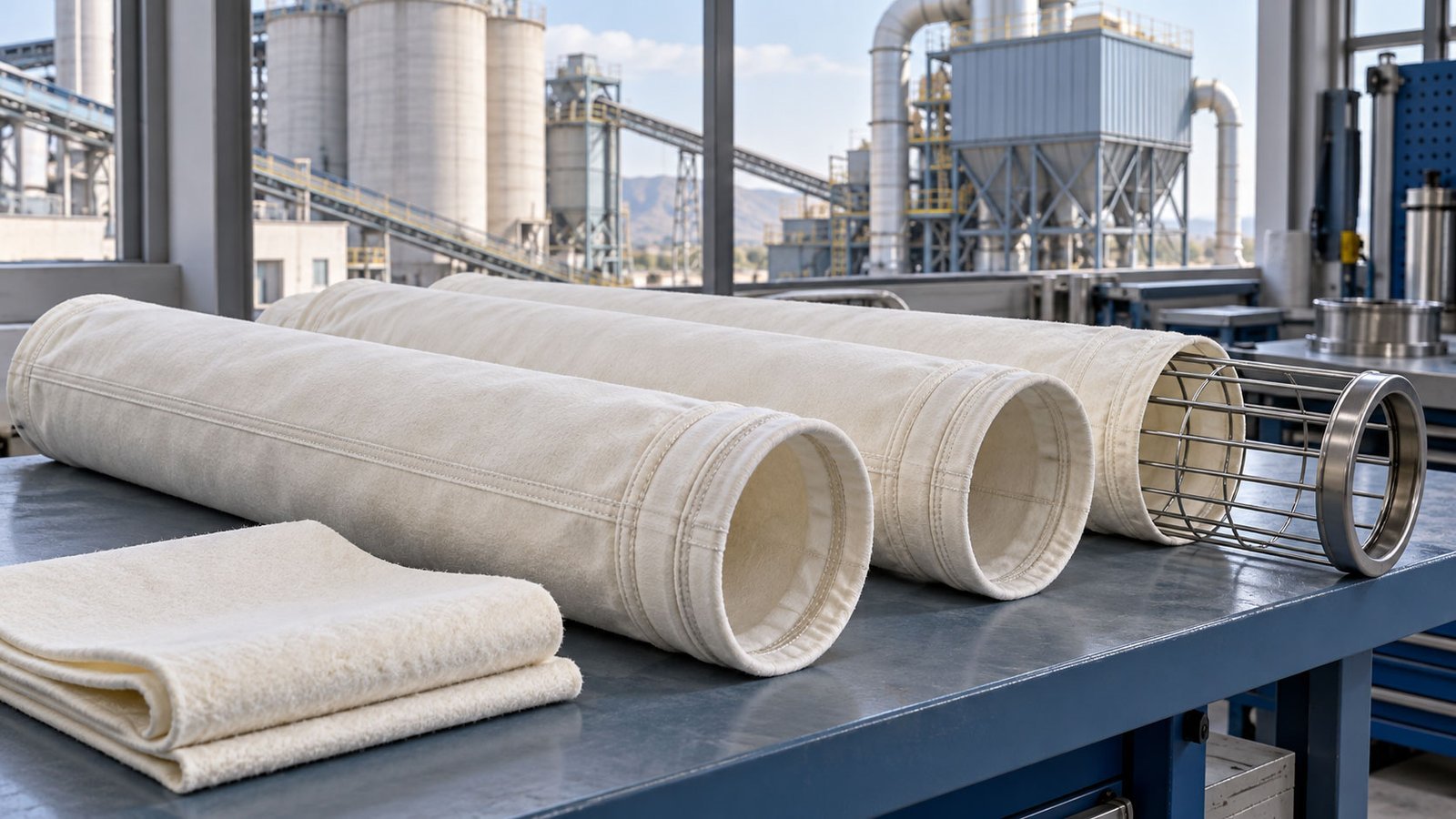
Acrylic Filter Bags in the Cement Industry
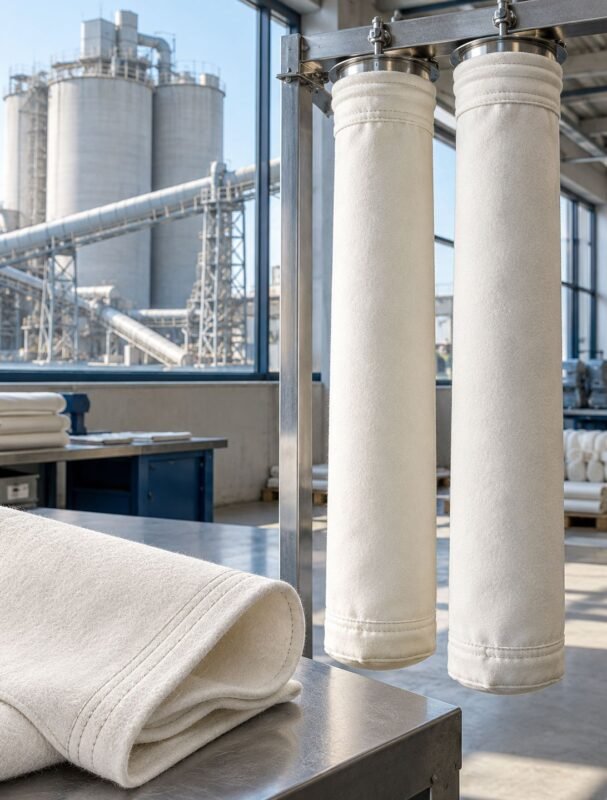 Acrylic filter bags are among the filter media considered for dust collection points in cement plants where temperature and gas conditions are suitable. Capturing particles generated at different production stages helps reduce dust released into the environment and supports dust control within the production area.
However, not all processes in a cement plant have the same characteristics. An acrylic filter bag that is suitable for one unit may be unsuitable for a hotter gas stream or one with a different chemical composition. Selection should be based on the operating conditions of each unit.
How do acrylic filter bags work?
As dust-laden gas passes through the filter media in a baghouse system, particles are retained on the surface and within the filter structure. The dust layer that forms on the surface is removed according to the system’s cleaning arrangement. Fibre structure, air permeability and surface properties affect particle capture and cleaning behaviour.
Alongside suitable filter material, correct bag installation, cage compatibility and reliable operation of the cleaning system are essential. Considering these factors together enables a more accurate assessment of filtration performance.
Assessing moisture and chemical conditions
Depending on the product’s fibre type, acrylic filter media may be considered for gas streams with moisture and certain chemical conditions. In particular, homopolymer acrylic and copolymer acrylic materials should not be assumed to have identical properties.
Chemical resistance varies with gas composition, temperature and moisture. The technical data sheet for the selected product should therefore be reviewed rather than relying solely on the material name “acrylic”. In gas streams containing acidic or alkaline constituents, the product’s suitability for those conditions must also be verified.
Temperature limits in cement processes
Acrylic filter bags should not be regarded as a universal solution for all high-temperature cement processes. Continuous operating temperature, short-term temperature increases and exposure duration must be compared with the product’s permitted limits.
If the operating temperature exceeds the limits of acrylic media, another filter material suited to the process conditions should be considered. Moisture and chemical compatibility are as important as temperature resistance.
Filtration performance and service life
The performance of acrylic filter bags depends on the dust’s particle size and abrasiveness, as well as the system’s filtration velocity. A correctly sized bag that is cleaned regularly helps manage surface dust accumulation. Service life, however, cannot be determined from the material type alone.
- Check the continuous and peak gas temperatures.
- Verify the acrylic fibre type and the product’s technical limits.
- Assess moisture and gas composition.
- Select a bag construction suited to the abrasiveness of the dust.
- Check bag dimensions and compatibility with the cleaning system.
When selecting acrylic filter bags for cement plants, maintenance requirements and expected service life should be considered alongside the purchase price. For a broader assessment, review the filter bag selection criteria for cement plants.